

How to Dispose of Redundant Servers Securely
- Alasdair Gemmell
- Jul 14
- 6 min read
A decommissioned server can still hold years of sensitive information: employee records, customer data, financial documents, credentials, backups and configuration files. Simply removing it from the rack does not remove that risk. Organisations that need to dispose of redundant servers securely need a documented process that protects data from the point of collection through to reuse, destruction or recycling.
For IT managers, facilities teams and compliance officers, the challenge is not merely finding a recycler. It is proving that each data-bearing asset was controlled, its information was irretrievably removed, and its remaining materials were handled lawfully. That evidence matters whether you are responding to an internal audit, preparing for a site move or managing a large technology refresh.
Why redundant servers need specialist handling
Servers are rarely straightforward items of waste electrical equipment. A single unit may contain multiple hard drives, solid-state drives, RAID arrays, removable media, internal flash storage and management controllers with stored settings. Older equipment may also include failed drives retained for troubleshooting, which are easily overlooked when stock is being cleared quickly.
Deleting files, reformatting a volume or resetting an operating system is not a sufficient disposal method. Data may remain recoverable, particularly where drives have been partitioned, encrypted incorrectly, removed from arrays or used in virtualised environments. The organisation that collected and used the data remains accountable for ensuring it is protected, including when the equipment reaches end of life.
The environmental position also requires care. Servers contain metals, circuit boards, batteries and other components that fall within WEEE obligations. Passing them to an unverified collector, placing them in a general waste stream or allowing informal resale can create both data-protection and environmental exposure.
Plan before you dispose of redundant servers securely
A controlled disposal project starts before collection day. Create an asset register that identifies each server by make, model, serial number, asset tag and location. Record the storage devices expected within each unit, including any drives that have already been removed. This makes it far easier to identify discrepancies before equipment leaves the premises.
Your technical team should determine whether any data must be retained for legal, contractual or operational reasons. Backup retention, financial records, healthcare information and client project files can all affect timing. Once the retention requirement has been met, remove the server from production, confirm that dependent services have migrated, and revoke access credentials or certificates that may remain associated with the hardware.
It is also worth separating equipment by likely outcome. Newer, working servers with market value may be suitable for testing, refurbishment and resale after certified data erasure. End-of-life or faulty equipment may need component recovery and WEEE-compliant recycling. The right route depends on condition, specification, age and the sensitivity of the data, not simply on whether the unit still powers on.
Choose the right data-destruction method
There is no single method that suits every drive. For reusable hard disk drives, verified software erasure can be appropriate when performed to a recognised standard and supported by a detailed certificate. It allows viable equipment to be refurbished, extending its useful life and potentially creating a rebate against collection or processing costs.
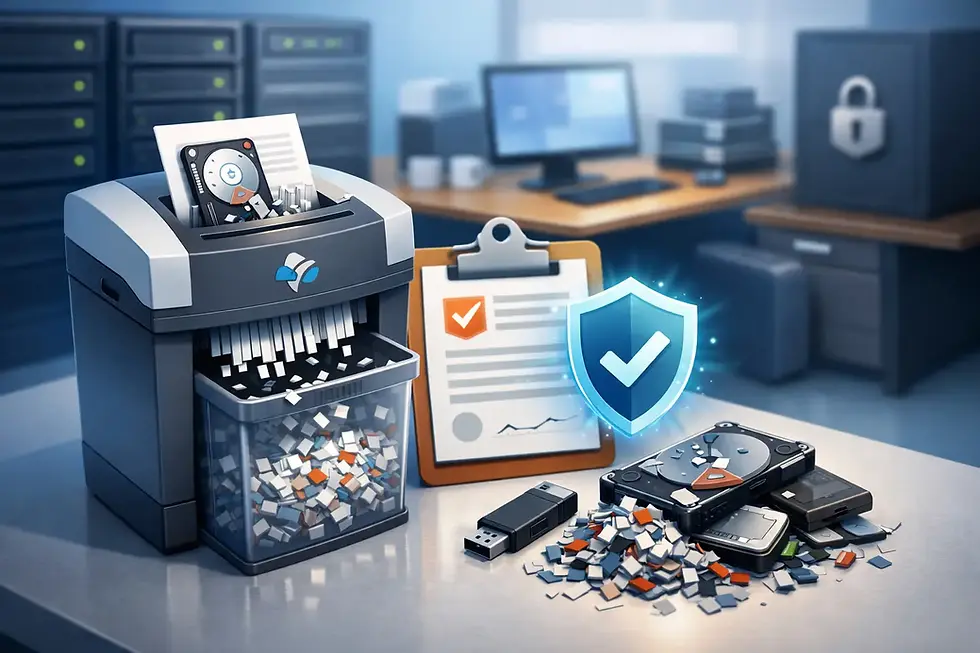
For failed, damaged or highly sensitive drives, physical destruction may be the better choice. This can involve shredding or another approved method that renders storage media unreadable. Solid-state drives require particular attention because their data is stored differently from traditional hard drives; an approach designed only for magnetic disks may not provide the intended assurance.
On-site destruction can be valuable where equipment cannot leave a secure location with data intact, such as public sector environments, schools, regulated offices or organisations with strict client requirements. Off-site destruction can be equally secure when collection, transport, receiving and processing are controlled through an auditable chain of custody. The decision should be based on risk, practical access and your organisation's policies.
Secure collection is part of the control
Data security does not begin at the recycling facility. It begins when a collection is booked. A suitable IT asset disposal provider should arrange a clear handover process, use trained personnel and provide collection documentation that records what has been removed from your site.
Unmarked vehicles can be sensible for businesses that do not want to advertise the movement of potentially valuable IT equipment. Secure transport and controlled loading reduce the chance of loss or unauthorised access while items are in transit. For larger clearances, a planned collection schedule also prevents servers being left unattended in corridors, loading bays or unsecured storage rooms.
At handover, retain records that connect your asset register to the collection paperwork. If a server is collected without its listed drives, document why. If a drive is separately destroyed on site, ensure its serial number is included on the destruction record. Small gaps in paperwork can become difficult questions during an audit.
The documentation your organisation should receive
Certificates are not simply administrative extras. They provide evidence that the disposal route matched your instructions and that sensitive materials were handled appropriately. The exact documentation will vary by project, but a well-managed server disposal should produce a traceable record from collection to final treatment.
Ask for documentation that covers:
collection or transfer records, including the date, site and equipment handed over;
an itemised asset report with serial numbers where required;
a data destruction or data erasure certificate that identifies the relevant media and method used;
WEEE-compliant recycling evidence for equipment that cannot be reused; and
reporting on refurbished or resold assets, including any agreed rebate where applicable.
These records support GDPR accountability and help demonstrate that the organisation took reasonable, proportionate steps to protect personal data. They are also useful for finance teams retiring fixed assets, procurement teams managing suppliers and sustainability reporting where reuse and recycling figures are needed.
Reuse, resale and recycling can work together
Secure disposal does not automatically mean destroying every server in full. Where a server is operational and commercially viable, certified removal of data can allow it to be refurbished or remarketed. This avoids premature waste, reduces demand for replacement materials and may recover residual value for the organisation.
That said, resale is not suitable for every asset. Very old servers can consume disproportionate power, have limited market demand or lack manufacturer support. Some organisations also have policies that require physical destruction of certain media regardless of asset value. A responsible provider should explain the trade-off clearly rather than treating reuse as the answer in every case.
Components that cannot be reused should enter an authorised recycling process. Drives and other data-bearing parts must be dealt with according to the agreed destruction method before materials are separated. The aim is to recover useful resources without creating an uncontrolled route for information to leave your organisation.
Common mistakes that create avoidable risk
The most frequent mistake is assuming that a server has no data because it has been switched off for months. Dormant equipment often contains precisely the material that has not been migrated or reviewed. Another is handing a mixed pile of IT equipment to a general clearance company without confirming how drives, tapes and removable media will be identified and processed.
Organisations also lose control when they remove drives internally but do not maintain a record of which drive came from which server. This may seem quicker during a busy office move, but it makes certification less meaningful later. Similarly, storing redundant servers in an unlocked cupboard while waiting for a collection turns an end-of-life project into an ongoing security risk.
A practical disposal route for London and the South East
For organisations in London, Kent and Canterbury, Essex and East London, Reading and the Thames Valley, Cambridge and surrounding areas, and Sussex, specialist collection can remove the operational burden of coordinating disposal internally. Larger projects elsewhere in the UK may also be suitable for planned collection.
Bioteknik manages the process from secure collection and transport through to data destruction, refurbishment, resale or WEEE-compliant recycling. For qualifying business volumes, collection may be available free of charge, particularly where reusable assets help support the recovery model. The key point is to agree the data-destruction method, asset reporting requirements and collection arrangements before equipment is moved.
When servers leave your estate, they should leave with a clear chain of custody, a defined treatment route and evidence that stands up to scrutiny. Treating redundant hardware as a controlled information-security task, rather than a last-minute clearance job, protects your organisation long after the rack space has been reclaimed.


Comments