Donate Refurbished Computers to Charity Securely

A business decision to donate refurbished computers to charity can create real social value, but only when the equipment has been handled securely from the moment it leaves your premises. A laptop that appears unused may still hold employee records, customer information, saved passwords or commercially sensitive files. Donation should therefore be part of a controlled IT asset disposal process, not an informal handover of redundant equipment.
For organisations in London and across the South East, the right approach protects data, supports WEEE compliance and gives usable technology a longer, more valuable life. It also gives charities equipment they can deploy with confidence rather than a costly collection of devices they cannot repair or safely use.
Why donate refurbished computers to charity?
Most organisations replace IT equipment because it no longer meets their operational needs, not because it has reached the end of its working life. A three or four-year-old business laptop may be unsuitable for demanding corporate software, yet still be highly useful for charity administration, training, job-search support, digital inclusion projects or community learning.
Refurbishment keeps functional hardware in use for longer and reduces the demand for new devices. This is a practical part of the waste hierarchy: reuse comes before recycling. It can also reduce the volume of equipment entering the waste stream while delivering a direct benefit to organisations working with limited technology budgets.
There is, however, an important distinction between donating equipment and donating an IT risk. Charities should not inherit devices with residual data, unreliable batteries, missing chargers, locked accounts or unsupported operating systems. A responsible programme assesses equipment before it is allocated for reuse, securely removes data, tests functionality and recycles anything unsuitable.
Data security comes before charitable reuse
Deleting files, reformatting a drive or removing a user profile does not provide sufficient assurance that data has been destroyed. Information can remain recoverable on hard disk drives, solid-state drives, servers, mobile devices and removable media. For businesses subject to UK GDPR and wider data protection obligations, the responsibility for personal data does not disappear simply because an asset has been donated.
A secure process starts with a clear asset inventory. Record the devices being released, including serial numbers, asset tags, device types and where applicable the storage media within them. This creates a reliable starting point for tracking equipment through collection, data erasure, refurbishment and final reuse or recycling.
The next requirement is secure chain-of-custody handling. Devices should be collected by a specialist provider using controlled transport and documented transfer procedures, rather than being placed in an unsecured skip, handed to staff or sent through untracked channels. Unmarked collection vehicles can be appropriate where discretion is needed, particularly for offices, public bodies and organisations handling sensitive information.
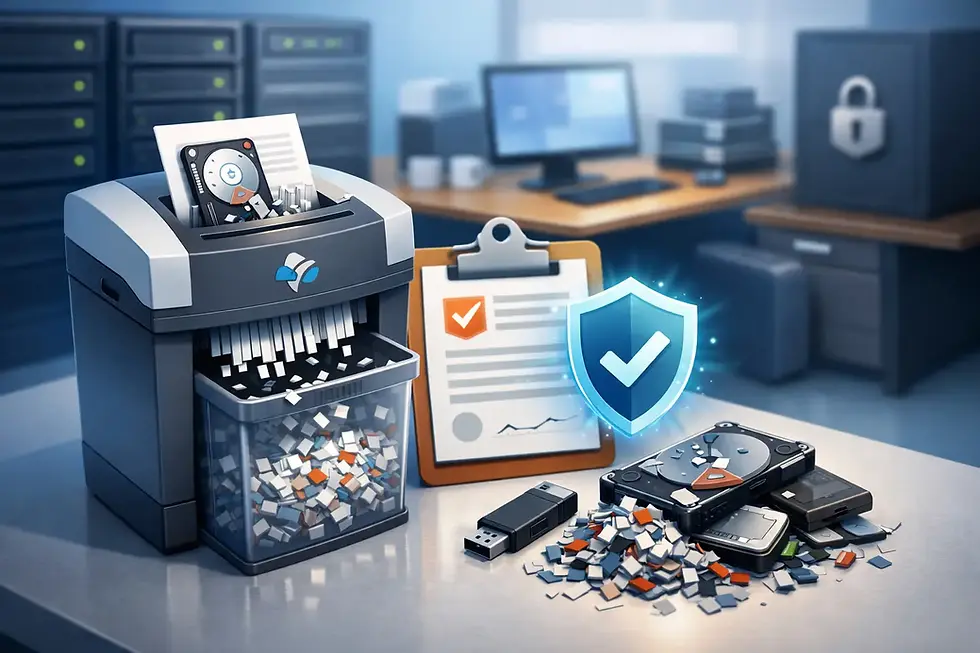
Data-bearing assets then need certified treatment. Depending on the device and its condition, this may mean verified software erasure or physical destruction of the storage media. The correct method depends on the media type, the sensitivity of the information and whether the device is intended for reuse. A reusable laptop can be securely wiped and prepared for a new user; a failed or damaged drive may need physical destruction instead.
The crucial point is evidence. Retain documentation showing what was collected, how data was destroyed and the final outcome for each asset or batch. Certificates of data destruction and asset reports support internal governance, audit requirements and regulator enquiries. They also help IT, compliance and facilities teams demonstrate that donation was managed as a controlled disposal route.
Assess which equipment is genuinely suitable
Not every redundant device should be refurbished. The value of a donation depends on whether the equipment is safe, functional and practical for the recipient. Equipment with damaged screens, swollen batteries, unreliable power supplies or obsolete specifications may create more work than benefit.
A professional assessment will normally consider age, condition, specification, cosmetic wear, charging capability and the availability of compatible accessories. Desktop PCs, laptops, monitors, tablets, docking stations and peripherals may all be suitable, but the recipient’s needs matter. A charity running remote advice sessions may value dependable laptops with webcams; a training centre may need matched desktop sets and monitors.
Software licensing needs equal care. Business licences, volume agreements and managed device configurations do not automatically transfer with the hardware. Devices should be removed from corporate management platforms, accounts and endpoint security systems before reuse. The recipient should receive a clean, usable device with a legitimate operating system arrangement, not a machine tied to its previous owner’s systems.
This is also where refurbishment adds practical value. Testing, repairing where viable, cleaning and configuring equipment helps ensure the donation is fit for purpose. If an asset cannot meet that standard, responsible WEEE-compliant recycling is the better route.
Build donation into your ITAD policy
Donation works best when it is planned before a refresh project begins. Leaving decisions until the office clear-out is underway can lead to missing asset records, rushed handling and uncertainty over who has approved the release of equipment.
Start by identifying the expected refresh volume and setting an internal decision process. IT can confirm which devices are no longer required and whether they can be removed from management systems. Compliance or information governance teams can define the required destruction standard. Finance may need visibility of residual value, while facilities or operations can coordinate collection access and storage.
There may be a commercial trade-off. Newer, higher-specification assets can retain resale value, which may support a rebate or help offset collection and processing costs. Older but serviceable equipment may be more appropriate for charitable reuse. A specialist ITAD provider can assess the batch and recommend the most suitable route by device, rather than treating every asset the same way.
A sound policy should also cover the exception cases: devices subject to legal holds, equipment with encrypted drives where keys are unavailable, damaged assets, leased equipment and machines containing specialist software. These cases should be resolved before collection, with decisions recorded.
What documentation should your organisation retain?
A donation programme is stronger when it can be evidenced clearly. The precise records will depend on your organisation’s policies and sector, but a well-managed project should provide an auditable trail from collection to final disposition.
This will typically include a collection record, an asset list or serial-number report, data destruction certification and confirmation of whether an item was refurbished for reuse, remarketed or recycled. Where equipment is passed to a charity, it is sensible to retain confirmation of the transfer and any agreed terms of use.
For regulated sectors, schools, universities, local authorities and organisations with formal information-security controls, this documentation is not administrative clutter. It is proof that a potentially high-risk activity was managed responsibly. It can also simplify annual environmental reporting and internal asset reconciliation.
Choosing a partner for secure charitable IT reuse
The charity relationship matters, but so does the organisation managing the equipment before it reaches that point. Look for a provider with established ITAD experience, secure transport arrangements, clear data destruction options and formal reporting. Ask how reusable equipment is tested, how non-reusable equipment is recycled and how chain of custody is maintained throughout.
It is worth checking whether the provider can handle mixed collections. Many office clearances include monitors, printers, networking equipment, cables, mobile devices and servers alongside laptops. A single controlled collection is generally more efficient than asking staff to separate, store and distribute equipment through several informal routes.
For businesses across London, Kent and Canterbury, Essex and East London, Reading and the Thames Valley, Cambridge and surrounding areas, and Sussex, local collection capability can make the process easier to schedule and supervise. Larger projects may also require UK-wide coordination. Bioteknik supports organisations with secure collection, certified data destruction, refurbishment and WEEE-compliant recycling, helping ensure that charitable reuse is supported by the same care as any other IT asset disposal route.
A donation that stands up to scrutiny
The best computer donations do more than clear a storeroom. They place useful technology with people who need it, while protecting the organisation that made it possible. That requires a clear inventory, secure handling, verified data destruction, realistic testing and documentation that follows every asset to its final destination.
When those controls are in place, donating refurbished equipment becomes a practical extension of your IT lifecycle policy: good for recipients, better for resource use and defensible under the scrutiny of auditors, customers and regulators.


Comments