Secure Data Destruction for Businesses

A redundant laptop in a store cupboard can create more risk than a live device on the network if nobody knows what data is still sitting on it. For organisations handling customer records, staff information, finance files or sensitive internal documents, certified data destruction for businesses is not a box-ticking exercise. It is a practical control that protects data, supports compliance and removes uncertainty when IT equipment reaches end of life.
Many organisations only start asking detailed questions when there is a clear-out, an office move, a lease return or a hardware refresh. By that point, the real concern is usually the same: where has the equipment been, what does it still contain, and who is accountable until the data is properly destroyed? Those are exactly the questions a documented disposal process should answer.
What certified data destruction for businesses actually means
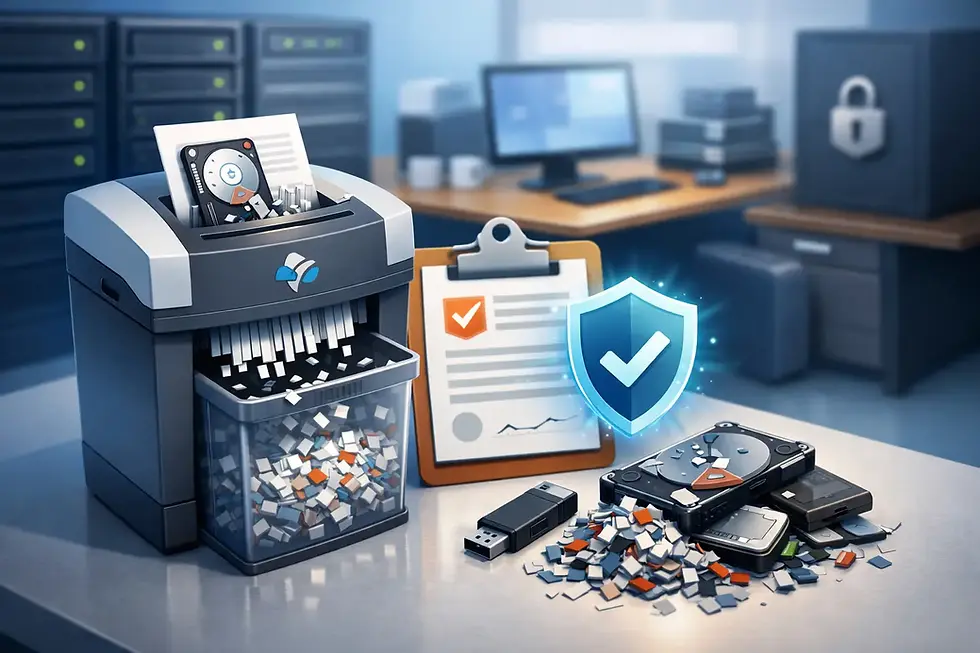
Certified data destruction for businesses is the secure erasure or physical destruction of data held on devices, backed by formal documentation. That documentation matters because disposal is not only about making equipment disappear. It is about proving that data-bearing assets were handled under a controlled chain of custody and processed in a way that meets legal, internal and contractual requirements.
In practice, this usually applies to laptops, desktops, servers, hard drives, solid-state drives, mobile devices, backup media and network equipment with onboard storage. It can also apply to printers, photocopiers and specialist devices that are often overlooked despite retaining images, address books or cached documents.
The word certified is where many businesses need more clarity. A certificate should not be treated as a decorative extra. It is the audit trail that confirms what happened to the asset and when. Depending on the service, that may include asset references, serial numbers, destruction dates, method used and confirmation that the process was completed in line with defined standards.
Why certification matters beyond simple disposal
If old IT equipment leaves your premises without proper controls, your organisation can still carry the risk even if the devices are no longer in use. Under UK data protection law, responsibility does not end when a monitor, server or laptop is loaded into a vehicle. If data is later exposed because a drive was not wiped properly or the chain of custody broke down, the consequences can include regulatory scrutiny, contractual disputes, reputational damage and avoidable internal disruption.
That is why certification matters. It gives compliance teams, IT managers and procurement leads something concrete to retain. During audits, insurance reviews, client due diligence or internal governance checks, documented destruction is far easier to defend than verbal assurances.
There is also an operational point here. Businesses often dispose of equipment in batches, across multiple sites, or under time pressure during relocations and upgrade programmes. In those situations, a provider with a repeatable process reduces the burden on internal staff. Facilities teams are not left storing obsolete devices indefinitely, and IT teams are not expected to improvise disposal controls around their day job.
Data wiping or physical destruction - which is right?
The correct approach depends on the asset, the data classification and whether there is any residual value worth recovering. Not every device needs to be shredded, and not every device should be reused.
Where equipment is suitable for refurbishment or remarketing, certified software erasure can be the better option. It removes data while preserving hardware value, which can help offset collection and processing costs. This is often a sensible route for newer business-grade laptops, desktops and some mobile devices.
Physical destruction is usually chosen where reuse is not appropriate, the media is damaged, the risk profile is higher, or the organisation's policy requires irreversible destruction. For failed drives, heavily encrypted environments with strict disposal rules, or media from regulated settings, shredding or crushing may be the more appropriate choice.
There is no one-size-fits-all answer. A sound provider should explain the trade-off clearly. Wiping supports reuse and sustainability where devices are viable. Physical destruction gives finality where policy or risk demands it.
What a secure process should look like
A credible service starts well before any wiping software or shredding machinery is used. Collection, transport and asset handling are part of the security process, not separate admin steps.
First, equipment should be inventoried and prepared for collection in a way that reduces ambiguity. Businesses do not always have perfect asset records, especially after years of moves, departmental handovers or mixed procurement. That is common, but the disposal process should still create a reliable record of what has been received.
Collection should then be managed securely, ideally by trained personnel using documented procedures. For many organisations, unmarked vehicles are preferable because they reduce attention during uplift from offices, schools, hospitals and commercial premises.
Once assets are in transit, chain of custody becomes critical. There should be no vague handovers, unsecured storage points or unclear processing route. Whether destruction takes place on-site or off-site, the organisation needs confidence that the same documented controls apply from collection to final certification.
After processing, the paperwork should be straightforward and usable. A certificate is only helpful if it supports your records and can be produced when needed. For larger projects, asset-level reporting is often particularly valuable because it ties the destruction outcome back to specific devices.
Compliance, WEEE and environmental responsibility
Data security is only half the picture. Organisations also need to dispose of equipment in line with environmental obligations. That means working with a provider that understands both certified destruction and compliant recycling.
If equipment cannot be reused, it should be processed through appropriate recycling channels rather than informal clearance routes. If it can be reused safely after certified erasure, refurbishment may be the more responsible outcome. Extending the life of usable hardware reduces waste and can support a more cost-effective disposal model.
This balance matters because secure disposal and environmental responsibility are not in conflict when the process is managed properly. In fact, they often support each other. A structured IT asset disposal service can destroy data, recover value from suitable assets and ensure non-reusable equipment is handled in line with WEEE requirements.
For many organisations, this is also where commercial practicality comes in. Newer reusable equipment may attract rebate value, while older equipment can still be collected and processed responsibly without creating a burden for internal teams. That is often a better outcome than holding obsolete devices on site for months because nobody wants to authorise the clearance.
Questions businesses should ask before choosing a provider
Not every recycler is set up for secure business disposals. If data protection, auditability and logistics matter, the provider should be able to explain its process clearly and without hesitation.
Ask how chain of custody is maintained from collection onwards. Ask whether destruction can be carried out on-site, off-site or both, and which option suits your environment. Ask what reporting is included, whether certificates can identify assets individually, and how non-working or damaged drives are handled.
It is also worth asking how reusable equipment is assessed, whether any resale value is returned, and how recycling is managed for obsolete items. A provider that can only talk about clearance but not compliance is unlikely to be the right fit for a business environment.
For organisations in London and the South East, response times, local coverage and collection practicality also matter. A secure process is easier to maintain when the logistics are established and the provider routinely works with businesses, schools, public sector bodies and multi-site estates in the region.
When to arrange certified data destruction for businesses
The obvious trigger is a technology refresh, but that is not the only time to act. Office relocations, server decommissioning, school IT upgrades, mergers, storage clear-outs and lease-end equipment returns all create disposal risk. So do one-off discoveries of old devices in cupboards, comms rooms and archive areas.
Leaving unused devices in storage often feels safer than disposing of them, but that can be misleading. The longer equipment sits unmanaged, the less reliable internal records become and the more likely it is that someone eventually disposes of it informally. A planned, certified process is usually the safer option.
For businesses that want a practical and compliant route, Bioteknik's approach reflects what most organisations actually need: secure collection, documented chain of custody, certified destruction, WEEE-compliant recycling and asset recovery where reuse is appropriate.
Certified data destruction should make life easier, not more complicated. When the process is well managed, you are not just clearing space - you are closing off risk, keeping records in order and making sure redundant IT leaves your business properly.


Comments