
Choosing a Business Electronics Recycling Company

A business electronics recycling company is not simply there to remove unwanted computers from site. It becomes part of your organisation’s data security, environmental compliance and audit trail. When laptops, servers, mobile phones or network equipment leave your control, the risk does not disappear - it must be managed through a documented process.
For IT managers, facilities teams and compliance leads, the right provider reduces the practical burden of an office move, hardware refresh or clear-out without creating a new GDPR or WEEE problem. The decision should be based on what happens to each asset after collection, not just on the collection price.
What a Business Electronics Recycling Company Should Do
A capable IT asset disposal provider should manage the full route from collection to final reuse, recycling or destruction. That means assessing equipment, recording its movement, addressing data-bearing devices securely and providing the evidence your organisation needs to retain.
The distinction matters because "recycling" can mean very different things. A supplier may collect equipment and pass it to another party, leaving you with limited visibility. A specialist provider manages the process directly or through controlled, audited downstream partners, with clear records of where assets went and how they were treated.
For many organisations, reuse should be considered before recycling. A recent laptop or server may still have commercial value after secure data erasure, testing and refurbishment. Reusing suitable equipment extends its working life, avoids unnecessary waste and can generate a rebate that offsets collection or processing costs. Equipment with no viable reuse route should be dismantled and recycled through WEEE-compliant channels.
Data security must come before disposal
A hard drive is not the only data risk. Data may be held on SSDs, mobile phones, tablets, USB storage, backup tapes, printer memory, network appliances and server components. Even devices that appear faulty can contain recoverable information.
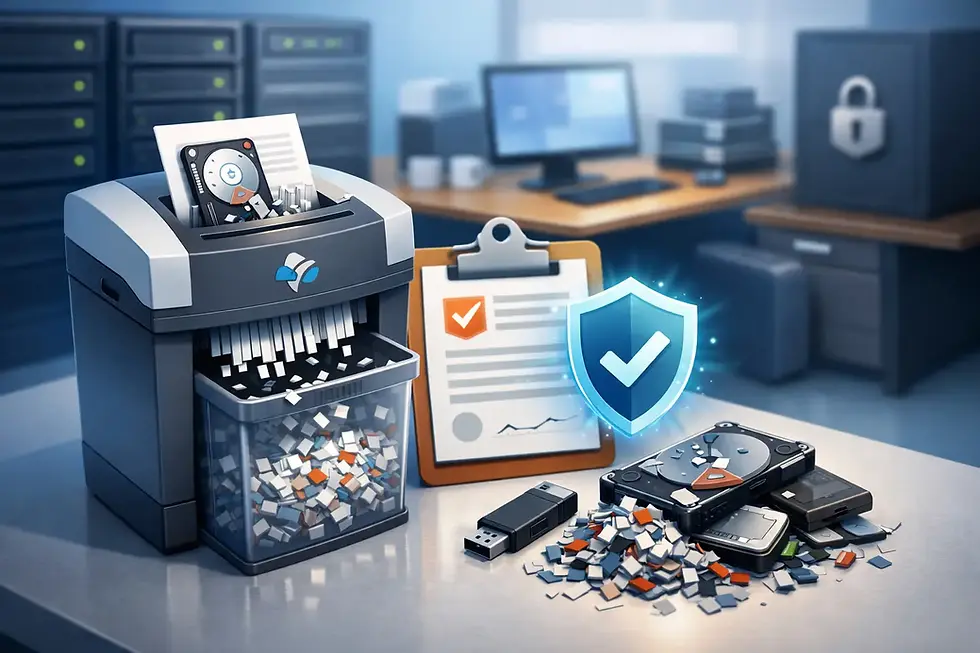
Ask a prospective supplier exactly how it identifies and processes these assets. Depending on the equipment, a suitable approach may involve certified data wiping, physical hard drive destruction or a combination of both. The right method depends on your data classification, internal policy, contractual requirements and whether the equipment is intended for reuse.
If an asset is to be refurbished and remarketed, securely verified erasure is normally needed to preserve the device’s value. If a drive has failed, contains highly sensitive information or cannot be reliably wiped, physical destruction may be the more appropriate control. What matters is that the method is recorded against the asset or batch, with a certificate or report that can be produced during an audit.
Check the Chain of Custody Before Collection
The most vulnerable point in a disposal project is often the handover. A quote that promises secure recycling is not enough if there is no evidence of who collected the equipment, how it was transported and when it reached the processing facility.
A reliable provider should be able to explain its chain of custody in practical terms. This includes trained collection staff, secure transport, collection documentation, controlled handling on arrival and traceable processing. Unmarked vehicles can be particularly appropriate where an organisation does not want to advertise the movement of IT equipment from its premises.
Before booking, establish whether assets will be counted or recorded on collection and what documents will follow. The precise paperwork varies with the project, but it should give your organisation confidence that the equipment has passed into a managed disposal process. For larger estates, serial-number reporting may be required. For mixed low-value equipment, a documented collection record and destruction or recycling certificate may be proportionate.
Do not overlook collection logistics. Can the provider collect from a restricted-access office, a school site, a multi-storey building or a location with limited loading space? Does it supply secure containers where equipment must be stored before collection? Clear planning prevents devices being left unattended in corridors, loading bays or shared storage areas.
Compliance Evidence Is Part of the Service
Under UK data protection law, organisations remain accountable for personal data until it has been securely erased or destroyed. Passing redundant equipment to a third party does not transfer away the responsibility to assess that third party and maintain appropriate controls.
Environmental responsibilities matter too. Waste electrical and electronic equipment must be managed correctly, with hazardous or controlled materials handled through the appropriate routes. Your provider should operate in line with relevant WEEE requirements and be able to explain how it prevents inappropriate disposal or uncontrolled export.
When comparing providers, request evidence that is relevant to the service being offered rather than relying on broad claims. Useful questions include:
How are data-bearing devices identified, wiped or destroyed?
What collection, data destruction and recycling documentation will be issued?
Which permits, registrations and quality or environmental management standards support the operation?
Is equipment processed in-house, and how are downstream recycling partners assessed?
How are reusable assets tested, refurbished and prepared for resale or donation?
A provider should answer these questions clearly. Vague assurances such as "all data is removed" or "everything is recycled responsibly" are not a substitute for a defined process and formal evidence.
Balance Security, Sustainability and Value Recovery
There is a genuine trade-off between the highest level of physical destruction and the opportunity to reuse equipment. Destroying every drive may be appropriate for some organisations, but it can prevent the reuse of otherwise valuable devices. Conversely, retaining assets for reuse without independently verified erasure creates an unacceptable data risk.
The best outcome is usually a policy-led decision. Identify which assets can be securely wiped and reused, which need destruction because of their condition or data sensitivity, and which components require specialist recycling. A good business electronics recycling company will help apply that policy consistently rather than treating every item in the same way.
Value recovery is also worth discussing early. Newer business-grade laptops, desktops, monitors, servers, switches and mobile devices may have resale value, particularly where they are complete, undamaged and supplied with chargers or accessories. An accurate asset list helps the provider assess eligibility and give realistic expectations. Older, damaged or incomplete equipment may still qualify for collection, but it is less likely to generate a rebate.
At Bioteknik, reusable equipment is assessed for secure refurbishment and remarketing after data handling, while unsuitable material is routed for compliant recycling. This practical model can support free or low-cost collections for qualifying volumes, while helping organisations reduce the environmental impact of premature disposal.
Choose a Provider That Understands Your Site and Region
A national provider is not automatically the best choice for every collection. For organisations with regular refresh cycles or several local sites, a regional specialist can offer quicker communication, practical site knowledge and collection arrangements suited to the building and volume involved.
Bioteknik supports organisations across London, Kent and Canterbury, Essex and East London, Reading and the Thames Valley, Cambridge and surrounding areas, and Sussex. Larger collections can also be arranged UK-wide. For a London office clearance, for example, secure access, timed collections and discreet transport can be as important as the final recycling route.
Local coverage should not mean compromising on documentation or standards. The provider should offer the same secure process whether it is collecting a few racks of redundant devices from a school or managing a multi-site technology refresh for a corporate estate.
Prepare for a Better IT Disposal Project
You can make collection safer and more efficient by preparing a basic inventory of what is leaving site, separating equipment that must be retained and identifying devices likely to contain data. Remove personal items, building access cards and paperwork from laptop bags or storage cabinets. Keep equipment in a secure area until the collection team arrives.
It is also sensible to involve the right internal people early. IT can confirm data requirements and identify specialist equipment. Facilities can coordinate access, lifts and loading arrangements. Procurement, information governance or compliance teams can review documentation requirements. This is especially useful where the project involves sensitive departments, public sector records or regulated information.
The objective is not merely to clear space. It is to close the lifecycle of your IT assets with evidence that protects your organisation. Choose a partner that can explain the process plainly, document every critical stage and give your team confidence that redundant technology has been handled properly.


Comments